.png)
It's the question almost every client asks once they get serious about retiring, and it's also one of the most misunderstood. Most people think about taxes the way they thought about them during their working years: one job, one W-2, one number on a paystub. However, retirement doesn't work that way.
In retirement, your "paycheck" often comes from multiple sources (Social Security, pensions, IRA withdrawals, maybe a part-time gig) and each one gets taxed differently. Mix them together in the wrong order, and you can accidentally push yourself into a higher bracket, trigger taxes on Social Security you didn't expect, or set off a Medicare premium surcharge you've never heard of. Mix them together the right way, and you can keep thousands of dollars a year that would've otherwise gone to the IRS.
Let's break down exactly how retirement income gets taxed, and walk through real examples so you can see it in action.
Here's the first thing to understand: not all retirement dollars are created equal. The IRS treats each income source differently:
Fully taxable as ordinary income
Partially taxable
Tax-free
Tax-advantaged, depending on your state
This is the core of why tax planning in retirement matters so much: you're not managing one tax bill, you're managing a blend of income sources that all interact with each other.
Here's something that surprises almost everyone: Social Security itself can become taxable, depending on how much other income you have.
The IRS uses something called "combined income" to figure this out:
Combined Income = Adjusted Gross Income + Nontaxable Interest + 50% of your Social Security benefit
For a married couple filing jointly:
Real example: Let's say Tom and Linda are 67 and retired in Cedar Rapids. They receive $40,000 a year combined in Social Security and pull another $30,000 from a traditional IRA to cover expenses.
If Tom and Linda had instead pulled $15,000 from a Roth IRA and $15,000 from their traditional IRA, their combined income calculation would look completely different — because Roth withdrawals don't count toward combined income at all. That single decision could mean the difference between 50% and 85% of their Social Security being taxed.
The takeaway for clients: the order you pull money from matters just as much as how much you pull.
Required Minimum Distributions are one of the most common ways retirees get blindsided. You spend your 60s drawing down savings carefully, staying in a low bracket and then RMDs kick in at 73 and force a big chunk of money out of your IRA whether you need it or not.
Real example: Sarah, 73, has $900,000 in her traditional IRA. Her RMD this year is roughly $37,900 (based on the IRS Uniform Lifetime Table). Combined with her $28,000 Social Security benefit and a small pension, she's now sitting at $80,000+ of taxable income- enough to push her from the 12% bracket into the 22% bracket, and potentially trigger an IRMAA surcharge on her Medicare premiums two years later.
This is exactly why the years between retirement and age 73, often called the "Retirement Red Zone" are so valuable for proactive planning. Strategic Roth conversions during those lower-income years can shrink the IRA balance that eventually generates RMDs, smoothing out the tax bill instead of taking it all at once in your mid-70s.
This one catches people off guard because it doesn't even feel like a "tax" but it functions like one.
IRMAA (Income-Related Monthly Adjustment Amount) is a surcharge added to your Medicare Part B and Part D premiums if your Modified Adjusted Gross Income crosses certain thresholds and it's based on your tax return from two years prior.
Real example: A single filer with MAGI of $103,000 pays standard Medicare premiums. But cross $106,000 (even by $1) and you jump into the next IRMAA bracket, adding roughly $74/month per person to Part B alone (current-year figures will vary). That's not a gradual increase- it's a cliff. One large one-time withdrawal (say, to pay for a new roof) can trigger a surcharge that lasts an entire year.
This is why we always ask clients to think two years ahead before taking any unusually large distribution.
The clients who pay the least in retirement taxes usually aren't the ones with the most money, they're the ones with the most flexibility. That means having income available from multiple "tax buckets":
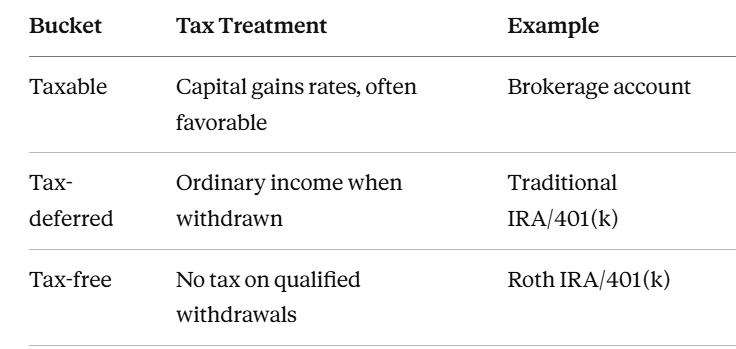
Real example: Dave needs $70,000 this year. If it all comes from his traditional IRA, he's taxed on the full $70,000 as ordinary income. But if he pulls $40,000 from his IRA and $30,000 from a Roth, only the $40,000 is taxable, potentially keeping him in a lower bracket, reducing the taxable portion of his Social Security, and avoiding an IRMAA bump altogether.
This is the entire argument for doing Roth conversions before retirement income sources all turn on. Every dollar moved into a Roth bucket while you're in a lower bracket is a dollar of future flexibility.
There's no single percentage that applies to everyone and anyone who gives you a flat number without looking at your full picture is guessing. Your actual tax rate in retirement depends on:
What we can tell you is this: most retirees we work with are pleasantly surprised by how much control they actually have over their tax bill-once they see the full picture and build a plan around it instead of reacting to it year by year.
Taxes in retirement aren't a single number, they're the result of dozens of small decisions made over 20–30 years: which account you pull from, when you claim Social Security, whether you convert to Roth, and how you time large withdrawals. Get those decisions right, and you can meaningfully extend how long your money lasts. Get them wrong, and you could hand over tens of thousands of dollars more than necessary (without ever realizing it was avoidable).
That's exactly what a Retirement Architecture Review is built to uncover: a full picture of how your income sources interact, where the tax traps are hiding, and how to sequence your withdrawals for the lowest lifetime tax bill possible.
Curious what your retirement tax picture actually looks like? Schedule a complimentary Retirement Architecture Review and let's map it out together.
Yes. Many retirees still owe federal income taxes depending on where their retirement income comes from.
They can be. Up to 85% of your Social Security benefits may be taxable depending on your combined income.
Qualified Roth IRA withdrawals are generally tax-free.
No. Eligible Iowa retirees generally do not pay Iowa income tax on qualifying retirement income such as pensions, IRAs, and 401(k) withdrawals.
IRMAA is an income-related surcharge that can increase your Medicare Part B and Part D premiums if your income exceeds certain thresholds.
Potentially, yes. Strategic Roth conversions before Required Minimum Distributions begin may reduce future taxable income and provide greater flexibility.
This article is for educational purposes only and does not constitute tax, legal, or investment advice. Consult a qualified tax professional regarding your specific situation.

Financial Advisors in Cedar Rapids, IA
Helping you create a stress-free, simplified retirement
Investment advisory services are offered through Fusion Capital Management, an SEC registered investment advisor. The firm only transacts business in states where it is properly registered or is excluded or exempted from registration requirements. SEC registration is not an endorsement of the firm by the commission and does not mean that the advisor has attained a specific level of skill or ability. All investment strategies have the potential for profit or loss.